


I Need Your Human Aggregated Content
If you have a way of tagging or marking the good content you read online -- such as adding it to a specific category on your blog, bookmarking it through Delicious, or putting the link on some other online site -- send me the RSS feed for it, and I'll add it to the Yahoo Pipes aggregated feed that I have going with Writer River.
Here's what the Yahoo Pipes feed looks like at the moment.
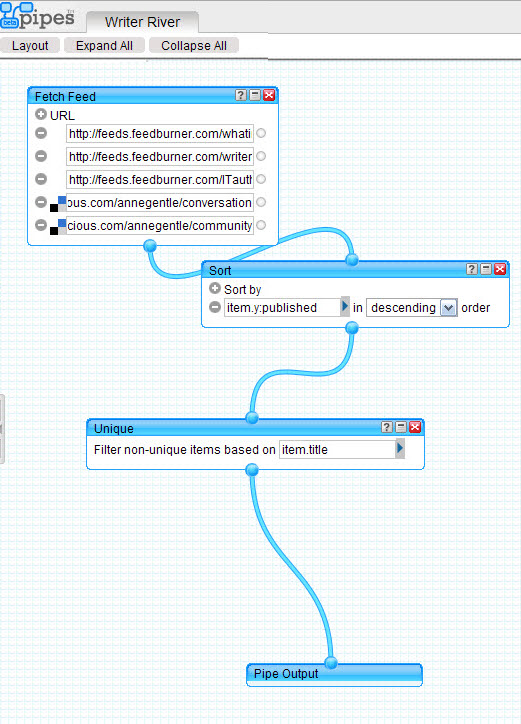
It's simple compared to other Yahoo Pipes feeds. Basically the pipe takes RSS feeds from as many sources as I add here, sorts the posts by the date published, filters out any duplicate titles, and then merges all the information into one RSS feed. Writer River then displays this RSS feed on its home page. When you subscribe to the Writer River RSS feed (or when you subscribe to Writer River's email delivery or Twitter updates), you're also subscribing to this same Yahoo Pipes feed.
I'm convinced that human-assisted aggregation and filtering, with the help of such tools as Yahoo Pipes, is the trend for managing the deluge of information online. Since everyone is an author, publishing on separate sites, RSS is the only way to keep up. And people are publishing like mad, pushing out about a million posts a day.
Post titles are often hit and miss in terms of quality, so some human filtering is necessary. We need people to pick and choose the good content from the poor. People are naturally doing this all the time. I'm just trying to leverage those efforts in an effortless way to pull all of this good information into one running feed. This is what Writer River is all about. It attempts to gather all of this worthwhile content and help you find better information more quickly. If enough people participate, the quality of content flowing through Writer River could easily surpass the quality of any print publication.
Here's an example. I like UXMatters, but I missed the latest articles published on it because I have hundreds of feeds in my feedreader and I don't sit there watching feeds all day. However, Alistair Christie saw an interesting UX Matters article by Mike Hughes and posted briefly about it in his What I'm Reading category. I saw it on Writer River because Alistair told me about his What I'm Reading feed, and I added it to the Yahoo Pipe that's feeding Writer River. I checked out the article tonight and immediately felt it was a valuable post. Without this human filtering and aggregation, I would have missed the post.
Now imagine if not just one or two people submitted similar What I'm Reading or What I'm Bookmarking feeds to Writer River, but dozens, even 100 people. It would be like having 100 researchers scouring the Internet for you, looking for the best posts available.
Here's a little more math. Let's say on average, the 100 researchers post one article a day to their What I'm Reading feed -- one article a day they feel is worthwhile. In one month, that would be 3,000 articles.
Now of course not everyone has the same interests and tastes as you, so let's say that only about 10% of these "worthwhile" articles are actually interesting to you. That still means that in one month, you'll have 300 worthwhile articles to read.
Compare that to static print publications like the Tech Comm Journal, Intercom, the Communicator, or other print publications, which only have about 10 articles per issue, and you begin to see how valuable and powerful human aggregated content can be. This is the rationale behind Writer River. We now need more people to add feeds to it.
The manual method of going to the Writer River site and publishing a link to your post is somewhat archaic. It takes time and is slow. It takes effort. But the RSS feed doesn't take effort. It only asks that you share your what-I'm-reading RSS feed with the Yahoo Pipe (by sending it to me, so I can add it), and then you don't ever have to return to the site again. Content will just flow through the feed, however you choose to subscribe to it.
It makes sense to somehow mark or tag or bookmark or post or share or tweet good content that you read, right? You want to hang on to that article somehow so that you can find it later. That's the nature of reading. But for online content, you need a method for keeping track of it, because the World Wide Web is too deep and wide and slippery to find something again after letting it go.
For those people who don't have a blog or Delicious account, or Identi.ca or some other way of posting or marking content, I recommend starting one. One of the easiest ways to keep track of your good reads is through a WordPress.com blog, which is free, requires no maintenance, and provides you with an easy-posting bookmarklet that allows you to quickly add a link in two clicks from any page you're reading.
Let's pull together these efforts. Rather than having everyone run in their own direction, which accomplishes little, let's harness all these individual efforts (which people are already doing) and turn them into a massive collective effort that dwarfs anything one simple person can do alone. Send me your category-specific RSS feed or links page and we'll build an information machine that churns out the best content of the web without requiring you to do much at all to find it.
About Tom Johnson

I'm an API technical writer based in the Seattle area. On this blog, I write about topics related to technical writing and communication — such as software documentation, API documentation, AI, information architecture, content strategy, writing processes, plain language, tech comm careers, and more. Check out my API documentation course if you're looking for more info about documenting APIs. Or see my posts on AI and AI course section for more on the latest in AI and tech comm.
If you're a technical writer and want to keep on top of the latest trends in the tech comm, be sure to subscribe to email updates below. You can also learn more about me or contact me. Finally, note that the opinions I express on my blog are my own points of view, not that of my employer.