

Becoming a Writer -- Reflections on a Trip to Idaho
Last week I drove up at Rexburg, Idaho to give a presentation on technical writing to the English majors at Brigham Young University Idaho (BYU-I) as part of their annual Pre-Professional Writing Conference. Most of the students in the group intend to pursue a literary career, such as writing books, editing manuscripts in publishing houses, or teaching literature in college or high school.
I was scheduled to present on technical writing, but my presentation felt more than that to me. I felt a mission to correct what had been falsely taught to me as a college student and which caused me to wander around for five years of my professional life trying to figure things out. Let me explain.
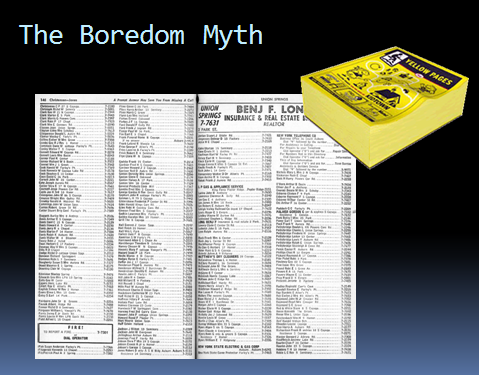
When I was a student at BYU Provo, I took an English survey course (typical of most English major curriculums). When the technical writing professor spoke to us (right after the cowboy literature professor, the feminist literature professor, and the postmodern deconstructionist professor), she explained that one task technical writers might do is format phone books. She then showed pictures of phone book layouts and mentioned font.
As I sat there, a young ideal-minded, writing-bound student, I took a personal vow to never become her. To never end up so boring, so undriven. Ending up in a little office, formatting phone books all day would be the equivalent of literary death. I eternally struck the possibility of technical writing from my career's vocabulary. Never, never, never would I become a technical writer.
After I graduated from BYU with a degree in English, I didn't know what to do, so I earned an MFA in literary nonfiction from Columbia in New York. All through my MFA, I felt anxiety about the career path I would follow. My wife gave birth to our first child at the time, and the cost of living in New York maxed out our income each month.
When I did graduate, I found a composition teaching job abroad at The American University in Cairo and spent the next two years in Egypt. After two years, I realized that my composition teaching career was going nowhere. I also realized I hated teaching -- a fact not often considered by prospective literature students who simply plan on teaching without ever having taught.
Above all, I despised grading student papers, justifying over and over the B and C grades. At one point I dropped my grading pen and noted that reading student essays was not only laborious, it was also damaging to my own sense of writing. I wanted to write, not teach. So I left composition teaching and moved back to the U.S.
With a BA in English, an MFA in literary nonfiction, and two years of full-time teaching experience, I wasn't marketable for any high-paying career. Through a friend of my sister, I landed a job as a copywriter for a Scientologist-heavy health and nutrition company in Clearwater, Florida, whose main product was a bottle of protein pills for triathletes. Earning 32k a year, without benefits, I wrote marketing copy for the company, exhausting my creative energy with press releases, web copy, product fliers, brochures, newsletter articles, email campaigns, and anything else I could write to promote and sell more BioBuild.
After six months, the $9,000 of savings I'd built up in Egypt steadily declined. One night I sat down to calculate my financial standings and realized I needed a higher paying job if I was to survive. At that point I remembered what a colleague in Egypt once told me, that I would be a perfect fit for technical writing. So I began my search for an entry-level job as a technical writer.
Thanks to some articulate copy I wrote about how protein works, a hiring manager at a financial company in Florida (who had a PhD in biology) saw potential in me, and together with a sample help file I wrote in RoboHelp, hired me onto their team. I was their first hire after four years of a freeze from the tech stock crash.
Sponsored
As a technical writer with little experience, I made only $40k a year, and so I soon took a second job teaching writing at ITT-Tech on the weekends. For the next year, I became a careful student of technical writing, mastering RoboHelp, Paint Shop Pro, and other tools; learning methods for procedural writing, memorizing the corporate style guide, and examining other corporate style guides; figuring out how to crack open a SME for information, how to gain access to the right development environments, how to organize chaotic jumbles of information, and finally how to package it all up into an attractive guide.
After working as a technical writer for a time, I found that it indeed was a good fit for me. Not only was I immersed in technology, I also had a knack for clarity and organization with technical material. I was also an expert at the tools, hacking Robohelp's source files to create a branded skin, and producing large amounts of documentation in a relatively quick timeframe.
Eventually my salary rose enough that I could quit my second job. After about a year, I was promoted to a senior level, which included even more salary increases. I later transitioned to another company that paid better. But more than simply finding a sustainable salary, I felt I finally found my career -- the answer to the elusive question about what to do with my writing skills. I'd found the path that I once sat up late at night wondering about while I was an MFA student, and while I was teaching in Egypt. My daily work didn't involve formatting phone books, and it wasn't boring at all -- at least not as boring as I imagined it could be.
As a result of these experiences, my presentation to BYU Idaho students was more than just a survey of possible technical writing careers. I was dispelling the myth that the BYU tech. comm. professor taught years earlier. Life as a technical writer does not actually consist of dreadfully dull tasks all day. I now had a chance to point students in the right direction before they spent the next five years of their lives wandering in financial frustration, trying to support a family on the notion that they would teach or write a bestseller.
Grammar
To kick off the Pre-Professional conference, Marilyn Arnold, a distinguished writer from BYU-Provo, gave the opening keynote address. Arnold read a lengthy personal essay on what it means to become a writer. I was surprised to see her read her opening address, but her text was well-written, funny, and full of examples. The only problem was that she focused -- for the first 20 minutes -- entirely on the heightened awareness of grammar that grips writers' minds. You begin to see every little comma error, every misuse of lay and lie, every misspelling, she said. And you're tormented by these language errors.
Sure, I'm guilty of the same hyper-grammatical mindset at times. But a writer is much, much more than a grammarian. A writer actively thinks; he or she has a keen sense of analysis and perspective. A writer can communicate with clarity and flair in ways others can't. A writer can structure content with story.
While correct grammar is important, if it's your main perspective, you sell yourself short. In the world of technical communication, you mislead others into thinking you can only proofread text on the user interface, rather than improve the overall design. I wanted to raise my hand and say, Is that it? Is grammar expertise all you gain when you become a writer? She eventually did turn the corner into other larger topics, but all I remember about her talk is the emphasis on grammar.
Performance
I had a couple of other experiences that made me think about what it means to be a writer. While eating breakfast among the invited speakers, I sat next to a literature professor from BYU Provo who told me she refrained from blogging because "blogs were performative."
Of course you hear accusations every now and then that blogging is a navel-gazing, egomaniacal activity. But that's only true in some cases, for some people. Here the English professor had taken it to another level, comparing blogging to performance art, to people who sit down with the intent of merely inciting discussions on listservs, engaging in attention-getting techniques to direct the focus on to themselves without substance.
Isn't all writing, I suggested, performative to some degree or another? The minute you write with an audience in mind, you begin to deviate from your normal course of behavior. You begin considering what others will think and how they'll react. As a result you distort what you might write without that audience.
I tried to make my argument while expressing some understanding of her perspective. But in the end I think her performance contention was merely an excuse for not writing.
Before long, breakfast ended and we all started mingling with others. Personally, I've never met an egomaniacal blogger -- just people who like to write.
Critical Thinking
My host, Josh Allen, introduced me to at least a dozen colleagues. I later learned that Josh was a lone Democrat in a sea of Republicans. Rexburg, Idaho, it turns out, is a town that is 93% Republican. It makes rooting for Obama, or worse, putting Obama-Biden signs in your front yard, a risky activity that draws an immense amount of attention to yourself.
For the first two years at BYU Idaho, Josh kept silent when political discussions arose. But as the elections approached, he broke out of his shell and volunteered to be the faculty advisor for the college's Democratic club.
Josh did put Obama-Biden signs in his yard, and on three separate occasions, political vandals took down and shredded the signs. The acts of vandalism inspired him to write a detailed, thought-provoking letter to the local newspaper editor.
I think when politics comes up on campus, Josh sees it as an opportunity to help students think critically about the issues. He exposes logical gaps, points out problems with assumptions, and describes other poor thinking. Teaching students to think critically, so at least they won't automatically believe or forward senseless political emails, is practically one of Josh's missions in life.
A critical perspective is certainly at the heart of any writer's mindset. To think for yourself, to question assumptions, to look at issues from fresh angles and risk voicing a different opinion -- surely this is the first step in becoming a writer. This is the substance that the grammarian lacks, or that the performer is searching to possess. And yet, critical thinking alone is insufficient to become a writer. Becoming a writer takes more than merely a questioning mind and a mentality against herds.
Story
The most anticipated speaker at the conference was an Argentinian poet, short-story writer, and novelist named Ana Maria Schua, who'd flown all the way from Argentina and spoke with a heavy Spanish accent. The students packed into the auditorium to listen to Ana Maria Schua speak. She had an endearing laugh that punctuated her speech every once in a while -- the kind of laugh that made you laugh when she laughed.
Schua recounted her own journey to becoming a writer. At sixteen, she compiled her first book of poems, but struggled to find a publisher. She won various literary contests, which boosted her confidence. She compiled a book of short stories, which she also struggled to publish (but eventually did).
To write novels, she used existing structures as "cake pans," into which she inserted her own experiences. She combined different structures, characters, and plots to build Frankenstein-like texts. She had a gift for the language, she said, but had to learn the art of telling stories. Novels were a genre she had to study, but microfictions came naturally to her.
Schua offered plenty of insights into what it takes to become a writer:
- The first step in becoming a writer is to immerse yourself in reading. But if you require that advice, you'll never be a writer.
- Every act of writing is a negotiation between what you plan to write and what comes from your fingers.
- If inspiration is gone, replace it with perspiration. Writer's block doesn't exist in a copywriting agency.
- Limitations help you write. Absolute freedom is puzzling.
- You need to have a gift to be a writer.
- Vanity is a necessary attribute for writing -- you have to like what you write.
- "Eyes see more than imagination" -- Da Vinci. (Refers to the power of borrowing from reality rather than inventing from scratch.)
- Not everything you write is good or worth keeping. Selection -- the ability to delete -- is important.
- Bad male novelists write improbable adventure stories; bad female novelists can't see outside themselves.
Throughout her career, Schua published around 40 books (many were children's books, she noted). I found her talk motivating. I wanted to go home and immediately start writing stories and sketching out ideas.
Students asked questions for a good 30 minutes after her presentation, and others asked her to sign her books. She was an inspiring example of what each student could be when he or she became a writer. She exemplified the literary life.
My Presentation
I had so much anticipation and energy when I gave my presentation that I spoke for 60 minutes straight without engaging students with any questions. I purposely covered aspects of technical writing that students probably hadn't considered: video, wikis, illustrations, single-source publishing, blogs, podcasts, screencasts, information architecture, usability, quick reference materials, and the general immersion in words.
I showed surveys on the question of whether technical writing was boring. 89% of students thought it was boring, compared to only 7% of professionals. I played excerpts of podcasts, gave a live demo of single sourcing, showed examples of usability in everyday objects, and showed three entertaining video tutorial clips.
My second session involved 45 minutes of question and answers, during which I carefully answered every student's question with more articulation than usual. Fifteen more students attended the question and answer session than my 60 minute presentation.
In the end, did hordes of students turn their attention to a new, previously unplanned career in technical writing? Did they drop their desires to spend their careers writing novels or break into Random House as book editors?
Not really. A few students thanked me for my practical advice. One student said he was glad I mentioned that teaching isn't for everyone. Another said my advice was more practical and useful than the information someone gave the previous year. A faculty member asked me about wikis for one of his class projects, and some others who didn't attend my presentation nevertheless complimented on it, relaying they'd heard good things about it.
But really, the conference made me reflect on what it means to become a writer. We start out with grand literary ambitions in college. We want to author books that will become classics, or make others rethink the world through our writing. Could technical writing ever fulfill that creative drive to write? To put it more bluntly, if you became a technical writer, could you still feel inside that you had "become a writer"? Or as a technical writer, are you merely using your writing skills?
I think there is room for interpretation in the answer. Writer is a word that has gradations of meaning. In my world, I know I'm a writer, but I'm still longing to become the writer I want to be.
About Tom Johnson

I'm an API technical writer based in the Seattle area. On this blog, I write about topics related to technical writing and communication — such as software documentation, API documentation, AI, information architecture, content strategy, writing processes, plain language, tech comm careers, and more. Check out my API documentation course if you're looking for more info about documenting APIs. Or see my posts on AI and AI course section for more on the latest in AI and tech comm.
If you're a technical writer and want to keep on top of the latest trends in the tech comm, be sure to subscribe to email updates below. You can also learn more about me or contact me. Finally, note that the opinions I express on my blog are my own points of view, not that of my employer.