

Everything Is Miscellaneous -- The Problem with Classifying Information
 I heard a good podcast on IT Conversations called "Everything Is Miscellaneous." Dr. Moira Gunn interviews David Weinburger, one of the authors of the Cluetrain Manifesto (which was the Web 2.0 manifesto). One of Weinburger's points is that traditional models of classification are breaking down. Information cannot be neatly categorized and shelved anymore. Everything is thrown into a giant box labeled Miscellaneous.
His point is best expressed from this review by an information scientist (excerpted on IT conversations):
The big contribution of "Everything is Miscellaneous", I think, is the concept of "orders". "First-order order" is structuring, like the placement of sentences in a text or products on a shelf. "Second-order order" is classification, putting information into categories and subcategories, maps,, etc. "Third-order order" is tagging and other meta-data, which allow us to make our own categorization on the fly ("give me a list of all books in this bookstore, divided by century published and subdivided by genre"). It's a neat set of phrasing, and if the book is not remembered for anything else, hopefully that taxonomy will remain.
In other words, it's getting harder and harder to organize information. You can't merely put it into various categories and subcategories. You need to tag the information with abundant metadata and allow users to create the order they want. Or perhaps create a wide variety of views based on different arrangements, associations, and information from the metadata tags.
Reflections for Organizing Blogs
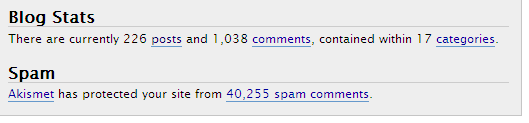
Looking over the 226 posts on my site, I know that archiving by category isn't working. I like the Related Posts feature more than the category archives, but neither really seems to make the blog navigable. I have an search feature and an index, but do they work for readers either?
In reality, I'd say 90% of regular readers just scan down the home page looking for interesting posts. The rest find my by Google. Weinberger's book looks like a good read because the explosion of information on the Web has aggrandized the importance of information architecture. At the STC Conference, Jack Molisani talked about the importance of becoming hyphenated. Information architecture is one area to develop expertise.
About Tom Johnson

I'm an API technical writer based in the Seattle area. On this blog, I write about topics related to technical writing and communication — such as software documentation, API documentation, AI, information architecture, content strategy, writing processes, plain language, tech comm careers, and more. Check out my API documentation course if you're looking for more info about documenting APIs. Or see my posts on AI and AI course section for more on the latest in AI and tech comm.
If you're a technical writer and want to keep on top of the latest trends in the tech comm, be sure to subscribe to email updates below. You can also learn more about me or contact me. Finally, note that the opinions I express on my blog are my own points of view, not that of my employer.