

Google CEO's Advice for People Entering a Technology Career: Stay Engaged, Keep Learning and Trying Things
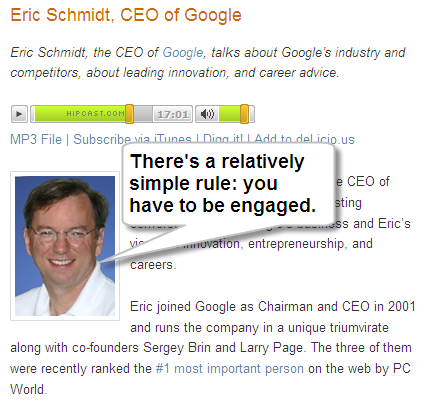
This podcast from iinnovate features Eric Schmidt, CEO of Google and, according to PC World, one of the most important people on the web. Around the 17 min. mark in the podcast, the interviewer asks Schmidt if he has advice for people entering technology and business in general.
Schmidt responds:
I think there's a relatively simple rule, which is that you have to be engaged. When you think about someone in their twenties, who is smart and capable, they're still learning how to run businesses, and there are many, many formative business experiences that they have. The more at bats you have (using the baseball metaphor) the better your luck. The more you're engaged, the more you're learning, the more you're trying things.
When I think back to what I did 20-25 years ago, when I didn't know anything at all, I practiced, I learned something, I learned here, I learned there, and so forth. And in some way I incorporate all that learning and knowledge today in my every day life.
The people who prematurely exit this, the people who say I'm going to do this for 5 years and then I want a better balance of life, for example, are not going to perform at the same level as the people who are systematically and coherently approaching the business learnings of their generation.
And so it seems to me that if you spend not a 5 year time, but rather a 30-40 year time, saying to yourself in that period of time, what are the business lessons I'm going to learn, how am I going to make sure that I am well situated fo the opportunities that come to me, then that's a much better approach.
 Schmidt's advice contrasts a bit with that of the MySQL CEO, Marten Mickos, who says "It is dangerous to hire someone who has too much experience." In Schmidt's view, the more "at-bats" (experiences) you have, the more situated you are to make good decisions for opportunities at the present. You can review the many previous experiences and apply what is best for the present situation. Rather than taint or bias your perspective, experiences enrich your perspective.
What is the evidence of engagement? How can you tell when one person is engaged and another isn't? How can you turn on the engagement switch?
I think a person is engaged when you see him or her writing, publishing, presenting, trying new tools, participating on listservs, blogs, and other new media — in short being visible in the community. When you're thinking about technical writing in your free time, you're engaged. Experimentations are not always successful, but even failures give you more knowledge for success in the future.
I am not sure why some are engaged and some aren't.
About Tom Johnson

I'm an API technical writer based in the Seattle area. On this blog, I write about topics related to technical writing and communication — such as software documentation, API documentation, AI, information architecture, content strategy, writing processes, plain language, tech comm careers, and more. Check out my API documentation course if you're looking for more info about documenting APIs. Or see my posts on AI and AI course section for more on the latest in AI and tech comm.
If you're a technical writer and want to keep on top of the latest trends in the tech comm, be sure to subscribe to email updates below. You can also learn more about me or contact me. Finally, note that the opinions I express on my blog are my own points of view, not that of my employer.