


Librivox: Open Source Audio Books; You Contribute Your Own Readings
Librivox is an open source audio archive. Not only can you download audio books (of texts in the public domain), you can also contribute your own readings of texts. That's right, let's say you have a penchant for Canterbury Tales. Well, record yourself reading it and add it to the site.
The cool thing about Librivox is that you don't have to read the entire book. Let's say you're just fond of the Miller's Tale in the Canterbury Tales. Fine. Just read that chapter. Others will read other sections, and through this cumulative collaboration, a free archive of audio books will soon rival Wikipedia in its scope, usefulness, and volume.
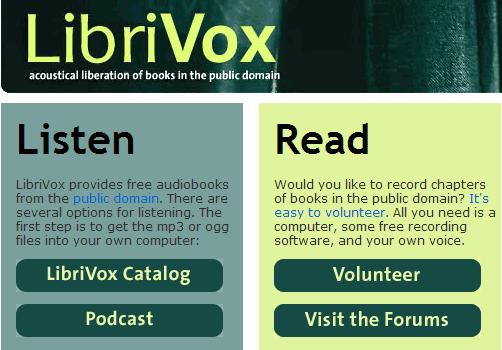
In fact, during the month of January alone, Librivox put out more audio books (37 books instead of 36) than Random House, one of the largest publishers of audio books in the U.S., explains Hugh Mcquire from Podcamp Toronto, who gave the full scoop on Librivox at his podcamp talk, "How to Get 2,427 People to Podcast for a Common Cause." Librivox published more than 300 audio books last year.
One appeal of Librivox is the variety of reading voices. An old woman with a warm husky voice may entrance with her reading. Another man with a strong Siberian accent may read the very next chapter. My personal favorite would be to hear the Geico Gecko narrate something. Then hear Andre Codrescu. Strung in a row, the variety must be suspenseful and entertaining as the stories themselves.
I e-mailed a friend who regularly listens to audio books and explained the concept of Librivox. Her reaction? Nice idea, but unless there's a monetary incentive for contributing readings, she won't be doing it soon.
This echoes another sentiment I heard last month about blogging — "What's in it for me?" Exactly what do you get in return for contributing to Wikipedia, for submitting to an open source audio archive, for creating a podcast or a blog? We're all contributing freely to an ever-growing mass of human knowledge.
How will you motivate users full of knowledge and talent to share the wealth? By contributing readings to an audio archive, you can fine tune your oratory skills, contribute to a good cause (think of all those listeners who will discover how fun Canterbury Tales is), join a community of enthusiasts with like interests, and expand your mind with community exchanges, but is it enough to drive you to the mic? Sure it is. Feeling part of something greater, connecting with others out there, being integrated in the constantly unraveling web — that's something worthwhile. Engaging in Web 2.0 is addictive the minute you throw yourself into it.
(As a cool sidenote, Librivox uses WordPress, an open source blogging platform. Thus, it's an open source audio archive built on open source software all done by unpaid volunteers.)
About Tom Johnson

I'm an API technical writer based in the Seattle area. On this blog, I write about topics related to technical writing and communication — such as software documentation, API documentation, AI, information architecture, content strategy, writing processes, plain language, tech comm careers, and more. Check out my API documentation course if you're looking for more info about documenting APIs. Or see my posts on AI and AI course section for more on the latest in AI and tech comm.
If you're a technical writer and want to keep on top of the latest trends in the tech comm, be sure to subscribe to email updates below. You can also learn more about me or contact me. Finally, note that the opinions I express on my blog are my own points of view, not that of my employer.