


Are We Moving Toward GooOS, the Google Operating System?
Joining the other online tools is Cellsea, an online photo editor. Now if you use Cellsea with Google Docs you can use an online word processor, a online excel spreadsheet, and an online photo editor (replacing your Snagit or Photoshop). Your WordPress blog is online, your banking is online, your news is online, your gmail is online, your photos are online with Flickr, your videos are online with Youtube. Now even your movies will be online with Netflix. What do you need your local harddrive for anymore?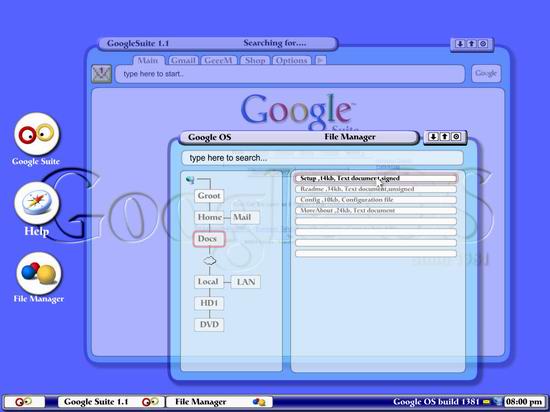
I found Cellsea intriguing, but not smooth enough to make me a convert. As bandwidth speeds increase, though, I think we'll see more online applications emerge. This is only the start. Many people think Vista will be the last operating system installed locally. Then Google will emerge with an online operating system, called by some GooOS (click on image at right to see full view (note — the image is from this site). The online operating system would not only be convenient, it would also have more information about users than ever before. Here's an excerpt from Jason Kottke's post:
So. They [Google] have this huge map of the Web and are aware of how people move around in the virtual space it represents. They have the perfect place to store this map (one of the world's largest computers that's all but incapable of crashing). And they are clever at reading this map. Google knows what people write about, what they search for, what they shop for, they know who wants to advertise and how effective those advertisements are, and they're about to know how we communicate with friends and loved ones. What can they do with all that? Just about anything that collection of Ph.Ds can dream up.
Think about all the data Google would collect if they ran an online operating system. Microsoft currently collects data from users if the users choose to participate and allow their info to be submitted (or so MS says). But Google saves information about every search and link and surfing pattern. You can watch the top keywords searched, or view trends. Apply that to the desktop environment, and you could collect some amazing data about how people use computers.
How does this apply to technical writers? You could analyze how people are using the applications you document. You could watch usage in real-time. You could apply heat maps to applications to see what areas users are clicking. You could really get inside the users' brains — if users had a little webcam, they could just flip it on and you could watch them use the application with their face in one corner of the screen while you observe their mouse moving in real-time. In short, it would make us technical writers a lot smarter about our users.
About Tom Johnson

I'm an API technical writer based in the Seattle area. On this blog, I write about topics related to technical writing and communication — such as software documentation, API documentation, AI, information architecture, content strategy, writing processes, plain language, tech comm careers, and more. Check out my API documentation course if you're looking for more info about documenting APIs. Or see my posts on AI and AI course section for more on the latest in AI and tech comm.
If you're a technical writer and want to keep on top of the latest trends in the tech comm, be sure to subscribe to email updates below. You can also learn more about me or contact me. Finally, note that the opinions I express on my blog are my own points of view, not that of my employer.