

Reading Blogs versus Reading Traditional Print Media
January 19th, 2007 | Posted in Blogging 11 Comments »
Yesterday my wife needed to use the computer for a while, and since we cut our cable TV, I decided to open up the Intercom to read some of the articles. After reading for about a half hour, I thought about the differences between reading blogs and traditional print media. My conclusion: the interactive nature of blogs makes the reading experience more enjoyable.
With Intercom, I first read Keith Hoffman’s Web 2.0 article. It was an informative read, but I felt myself wanting to make a little comment at the end of the article. Something like, hey Keith, it’s good ground you cover, but can you tie it back to technical writing more?
I then read my own article on podcasting. I realized I’d done the same thing — left out the topic of technical writing. Still, I liked the way I interwove the quotes into my article. Can you believe that 90% of those quotes came from podcasts I’d listened to while driving or working out?
I kept reading, including Neil Perlin’s article on how writing is becoming industrial (still not sure about that title), but I soon found that reading traditional print media is a bit boring, basically because there is no interaction with the material. Also, the content is very professional, which leaves the tone and structure a bit dry. Much of the writing in print magazines almost seems like I’m reading a report rather than a personal essay.
Compare this experience with reading blogs via Newsgator, an online service that compiles and sorts blogs I subscribe to. I have at least two dozen technical writing blogs that I track. Newsgator can allow me to read them one by one, or compiled and with the posts sorted by date.
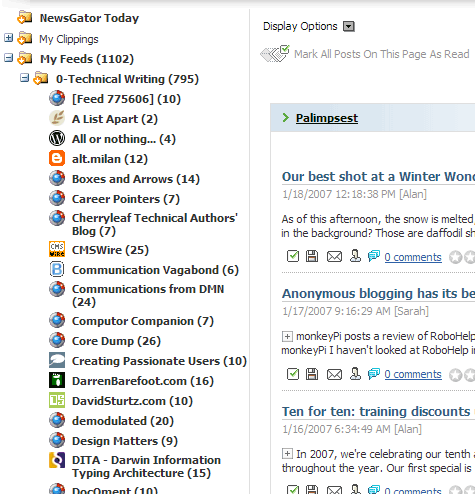
After reading Sarah O’Keefe’s Palimpsest blog, I see a link to Monkey PI and read his/her blog (the author is anonymous). After reading the Monkey PI article on RoboHelp, I leave a little comment. Then I move over to Bill Swallow’s blog, and find that he has mentioned a comment I left on the Char’s Helpstuff blog about my wanting to interview a SME on RoboHelp for Tech Writer Voices.
One blog takes me to another, and the reading experience becomes suspenseful and collaborative. I can comment, and others can respond to my comments, and I can link and be linked to. I both exist and have an influence as a reader.
Although much has been said about the ease of errors that blogging introduces, I find that the authenticity, realness, and candid tone (like being able to write the word “craptastic“) makes reading blogs more interesting than traditional print.
So my long term prediction here is that the traditional media will gradually fade and be replaced by blogging. Not only because blogging is more interactive and real, but with 1.3 million new posts each day, who has time to read traditional print books and magazines?
If you would like to comment on this post, use the comment feature below or link back to this post in your own post.
Twitter
Facebook


written down on the internet. The cultural network of the internet is influenced by the blogosphere. http://en.wikipedia.org/wiki/Blogosphere There are many people who seem to have preferences of reading and writing blogs over traditional print. (See:http://www.idratherbewriting.com/2007/01/19/reading-blogs-versus-reading-traditional-print-media)
Hi Tom,
Blogs are great for conversation. Magazine articles are perhaps better for longer, more authoritative discussion.
In addition to using RSS/Bloglines to track blog updates, I’ve just found blog comment tracking software (http://www.commentful.com). If I comment on a blog, I can track the comment trail so that I’m notified when there are updates.
I think this is another symptom of the evolution of the sharing of information. I too am often frustrated by non-interactive media. The printed word is a dinosaur that will be extinct before long.
Technical documentation is shifting from monolithic texts to context-sensitive snippets. Who’d have guessed Clippy the MS Office paperclip would be a prophetic avatar of technical communication?
This concept goes beyond print, of course. Taking a cue from Canada’s MuchMusic television station, several upcoming American game and reality shows will allow home audiences to cast realtime votes via cellular phones and the Internet to determine winners and losers.
I participated in an online debate on the topic of the longevity of the magazine industry a while back. The winning argument in favour of magazines? You can take them into the john. Paper can often go where computers can’t.
Tom,
It seems like only yesterday we were told that our collective offices would be “paperless” and today the prediction is for a world without print media.
While I wholeheartedly agree with the fact that the blog encourages interaction and is therefore more engaging, I still see a couple of issues that will prevent it from ultimately replacing print media entirely.
1. The ensuing discussion generated by a blog entry almost exclusively consists of the opinions of individuals who may not be experts in the topic being discussed.
The argument can be made that open discussion results in a more robust understanding of a given topic, however, it can also be shown that a group consensus isn’t always correct.
2. Printed media generally consists of higher quality printing which makes it much easier to read.
The research behind this JMLA article shows that “the most-cited reasons for preferring print included that the format was easier to read with better graphic quality, easier to browse, and easier to access. One user stated that with print, one was ‘not distracted by the process; with electronic [there are] too many loose ends, false trails, lack of ability to focus,’…”
It is highly likely that blogs and other electronic media will continue to create change in the world of print. Printed material has already changed. Just compare a recent printed copy of PC Magazine to one from 10 years ago and you will easily see the impact electronic media has had when you see the recent copy is only about one-fourth the size. But, even with a high tech audience, a print version still exists.
But, to illustrate an earlier point, this too is just an opinion by someone who’s work experience with printed media is somewhat limited.
Now, if you’ll excuse me, I have to clean that stack of papers off my desk.
Sarah,
Thanks for the tip about http://www.commentful.com. I was perusing that site and it looks really interesting. I assume you use it to keep on top of all the conversations you have going on in different spaces?
I agree that for longer, more authoritative discussion, print is preferred.
Brian,
Your comment about casting real-time votes via cell phone to influence a TV show sounds interesting. I want to try to make my podcasts more interactive, so I’m thinking of somehow soliciting questions from people ahead of time that I then put to the interviewee.
Re the mobility of print, yes, I agree, this is what makes print attractive (although about being able to take it to the john, someone told me that this was why he bought a PDA device and used Tiddlywiki).
I always hear about electronic paper and so forth, but that never seems to materialize.
Clyde,
How cool that you’re quoting from the Journal of the American Medical Association. I might just read the whole article.
Re having information from people who aren’t experts, I think people are trending towards the amateur opinion, at least in some instances. For example, if I buy a book on Amazon and read the customer reviews, I don’t mind if all the reviewers are off the street, rather than NY Times Book Review critics.
I have the same thoughts toward the tech writer voices podcast. I would like to interview more people who are simply unknowns — just regular tech writers, but perhaps with interesting ideas.
I hadn’t considered how electronic media had influenced print media, by making it shorter.
It’s cool that you’ve joined the world of blogging. Thanks for all your comments.
[...] with the author, click on links and learn more or get other perspectives, and being able to trade ideas with others makes but people don’t spend long hours reading their favorite book on the computer. People want [...]
Blogs are a great instant form of publishing, but I don’t think they will ever replace traditional print media. Also the amount of dead stagnant blogs out there means that very few are actually looked at regularly
[...] Podemos viajar por el tiempo en un simple clic. Este es un motivo más para aprovechar y alimentar el espíritu investigativo. No hay que tragar entero, tampoco esperar a recibir el número nuevo de la revista para aclarar una duda. ¿Por qué pensar que toda la información sobre un tema debe estar condensada en un sólo Post? [...]
Blogs mainly help in discovering new ideas and lot of business can be done with the help of it.